
Content Strategy for Graduate Recruitment
UW Communication Leadership
Time: June 2025 - Present
Role: Content Writer and Strategist
Tools: WordPress, Smore
Content Strategy for Graduate Recruitment
UW Communication Leadership
Time: June 2025 - Present
Role: Content Writer and Strategist
Tools: WordPress, Smore
Overview
Overview
When I started this internship, I wanted to answer one question: How do you make a graduate program feel real to someone who's never stepped foot on campus?
The answer wasn't just about listing courses or highlighting rankings. It was about finding the stories that made prospective students lean in and think, "This is where I want to be."
When I started this internship, I wanted to answer one question: How do you make a graduate program feel real to someone who's never stepped foot on campus?
The answer wasn't just about listing courses or highlighting rankings. It was about finding the stories that made prospective students lean in and think, "This is where I want to be."
Every month began the same way: sitting down with Associate Director Alex Stonehill and Marketing Specialist Matthew Joseph to brainstorm what prospective students needed to hear. What trends were shaping the industry? What questions kept coming up in admissions meetings? From these conversations, I'd develop article proposals and outlines, mapping out interview targets and research directions.
Then came the deep work — conducting interviews, digging through industry reports for the latest data, drafting articles, and hunting for the right visuals that wouldn't just fill space but enhance the story. After multiple rounds of revisions and approvals, each article went live. But the work wasn't done. I'd then reshape that content into newsletters, adding event announcements and additional sections to create a comprehensive monthly touchpoint for our audience.
Over 7 months, I developed monthly content campaigns — each combining blog articles, newsletters, and strategic interviews to connect with prospective students:
Every month began the same way: sitting down with Associate Director Alex Stonehill and Marketing Specialist Matthew Joseph to brainstorm what prospective students needed to hear. What trends were shaping the industry? What questions kept coming up in admissions meetings? From these conversations, I'd develop article proposals and outlines, mapping out interview targets and research directions.
Then came the deep work—conducting interviews, digging through industry reports for the latest data, drafting articles, and hunting for the right visuals that wouldn't just fill space but enhance the story. After multiple rounds of revisions and approvals, each article went live. But the work wasn't done. I'd then reshape that content into newsletters, adding event announcements and additional sections to create a comprehensive monthly touchpoint for our audience.
Over five months, I developed monthly content campaigns—each combining blog articles, newsletters, and strategic interviews to connect with prospective students:
The Work
The Work
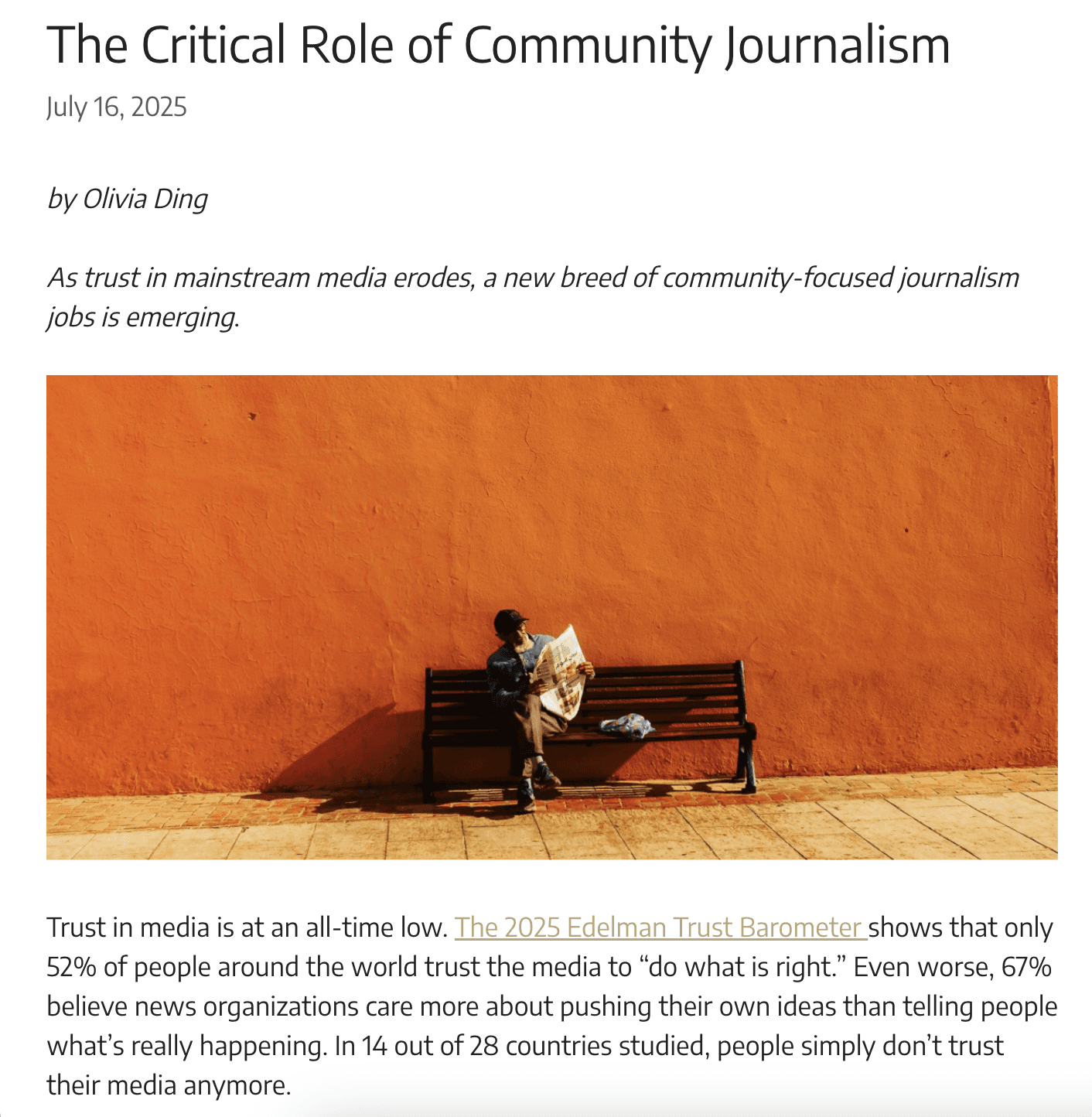
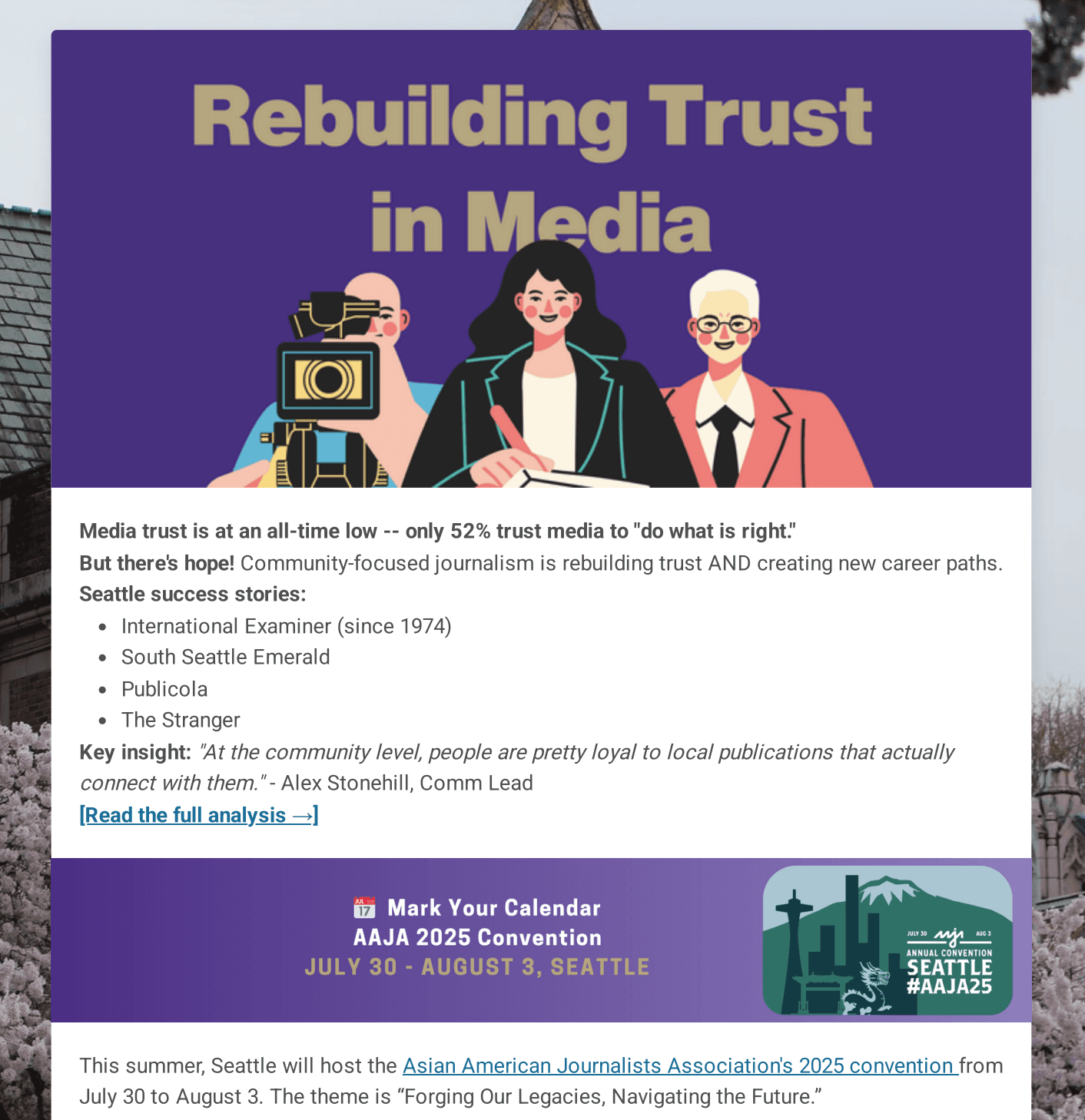
I interviewed faculty member Alex Stonehill and explored how local journalism is evolving amid declining media trust. Using data from the 2025 Edelman Trust Barometer, I crafted content that wasn't just promoting the MCCN track—it was giving readers genuine insights into why community-focused storytelling matters, whether they enrolled or not.
June: The Future of Community Journalism
Read Full Article
View Newsletter
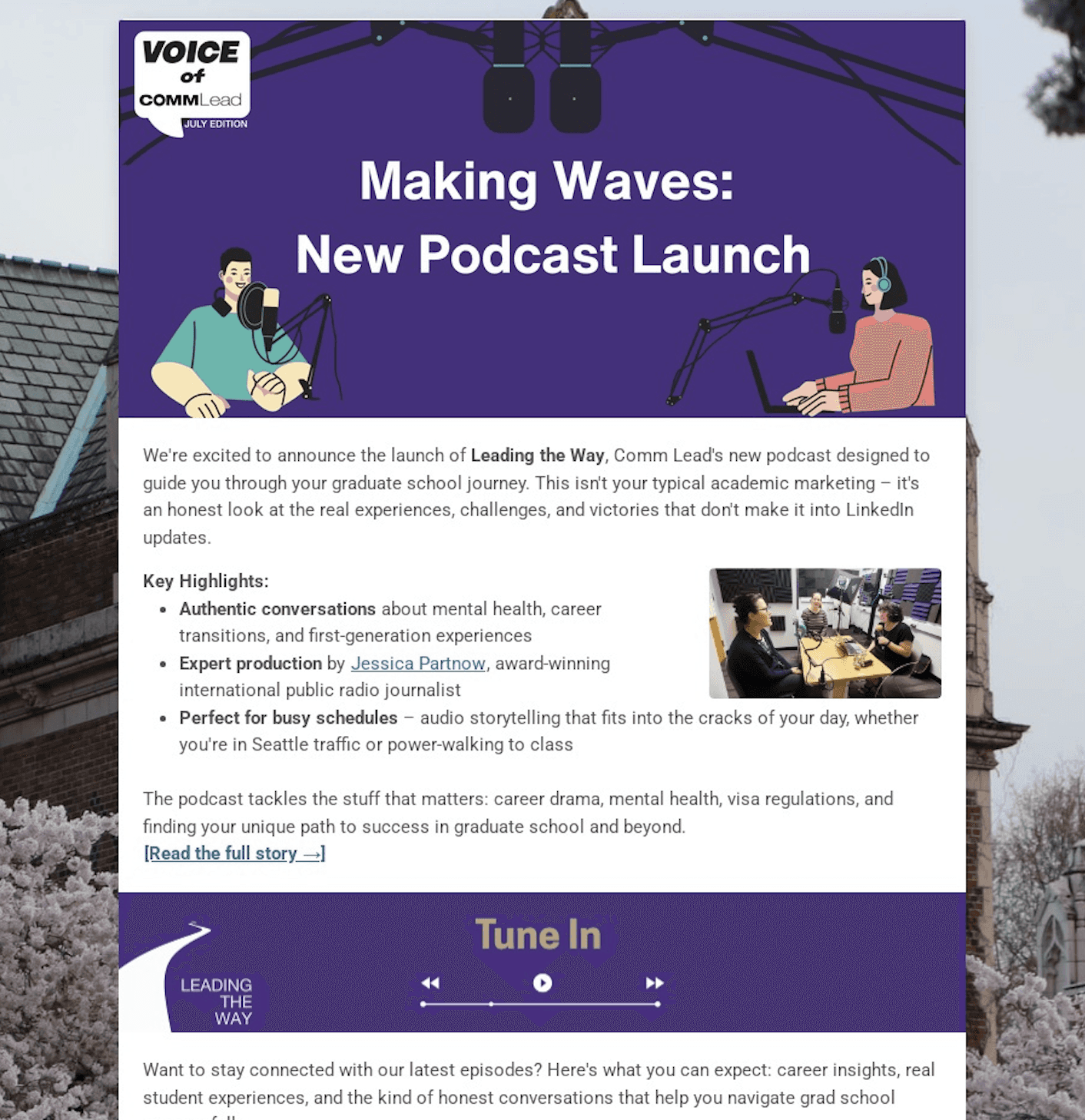
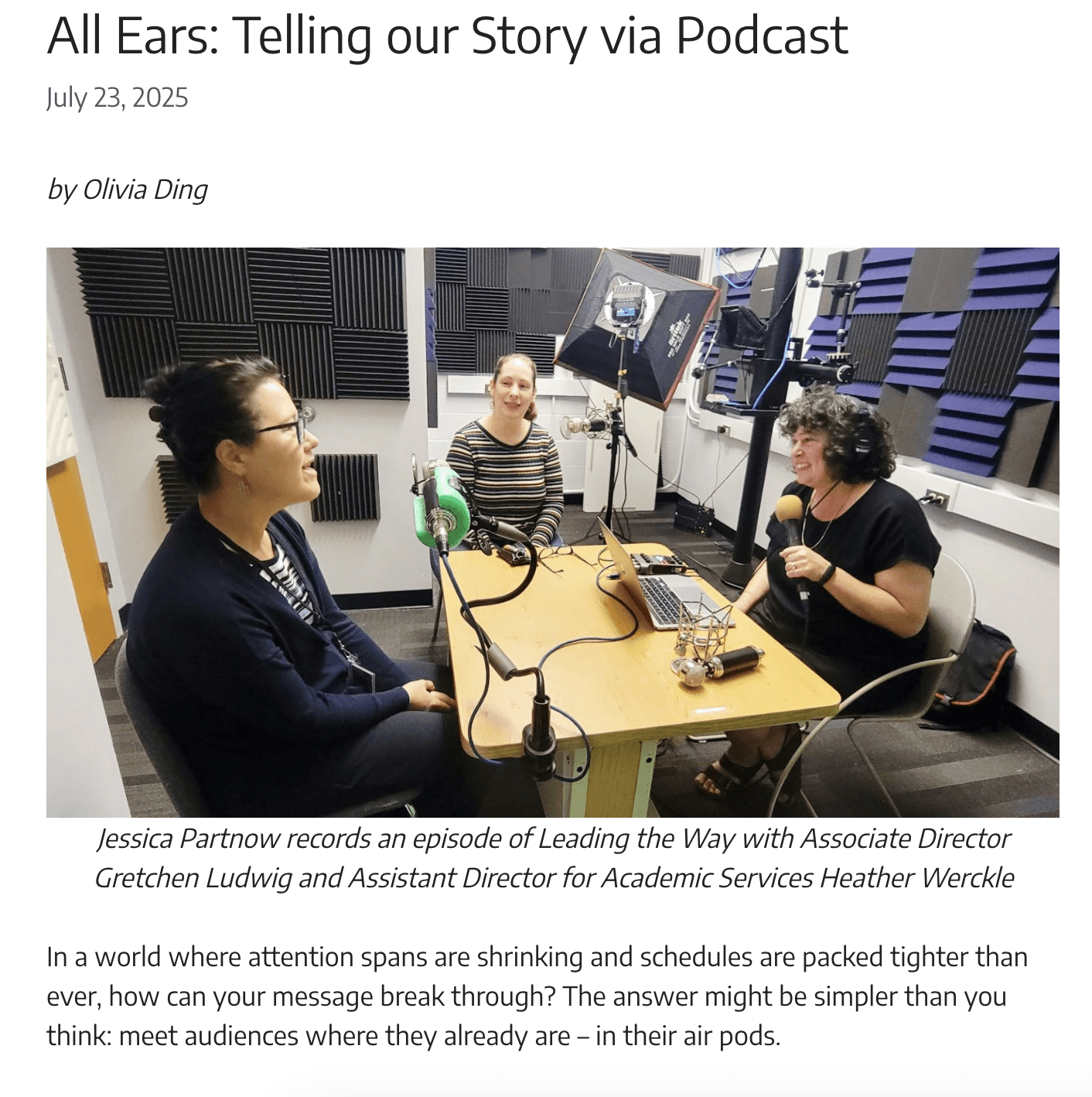
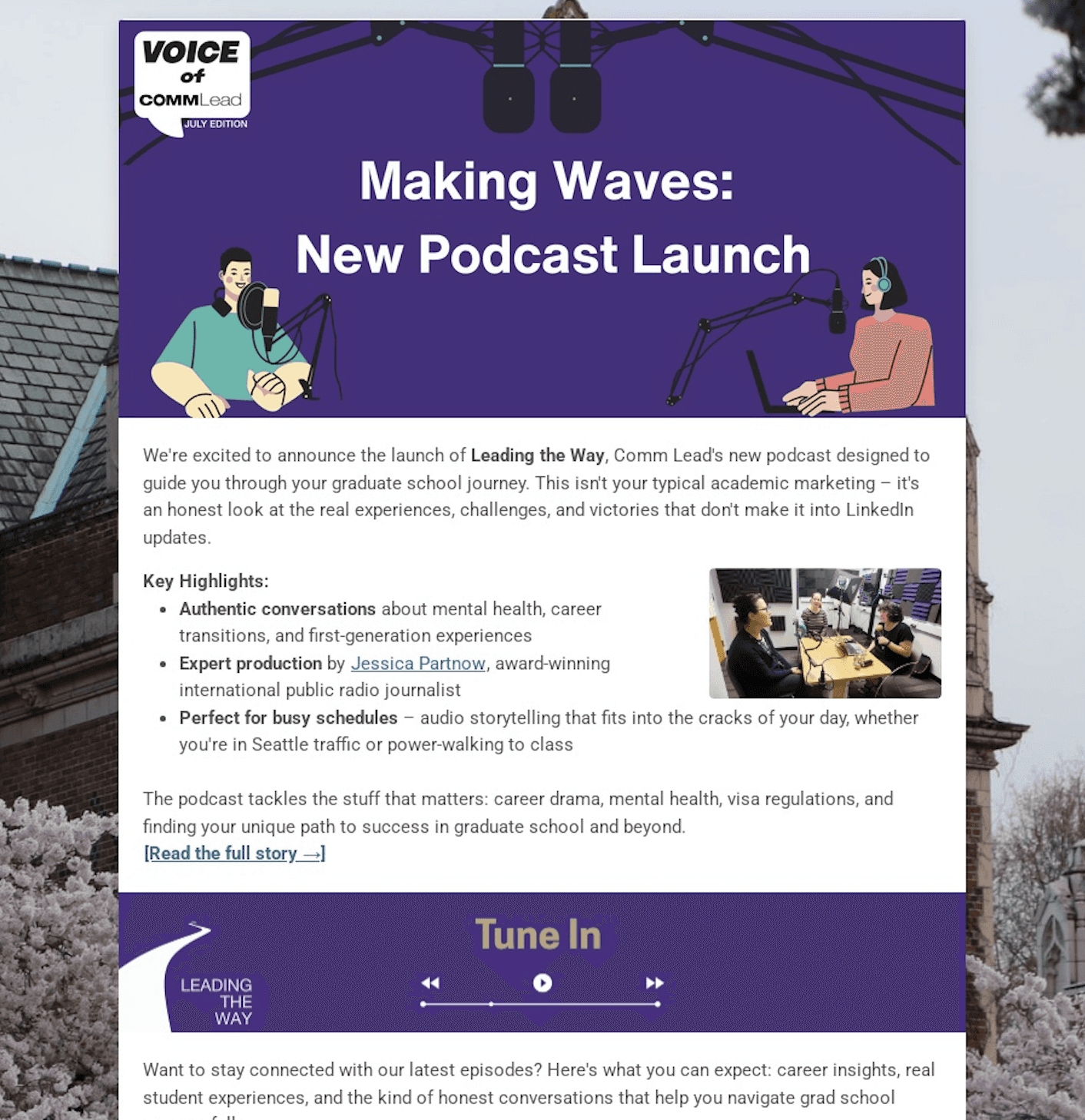
I spoke with podcast producer Jessica Partnow and her students about why audio storytelling works when attention spans are shrinking. The campaign introduced the program's new podcast while exploring podcasting as a content marketing strategy—practical insights for anyone in communications, with a natural invitation to learn more through Jessica's course.
July: Launching "Leading the Way" Podcast
Read Full Article
View Newsletter
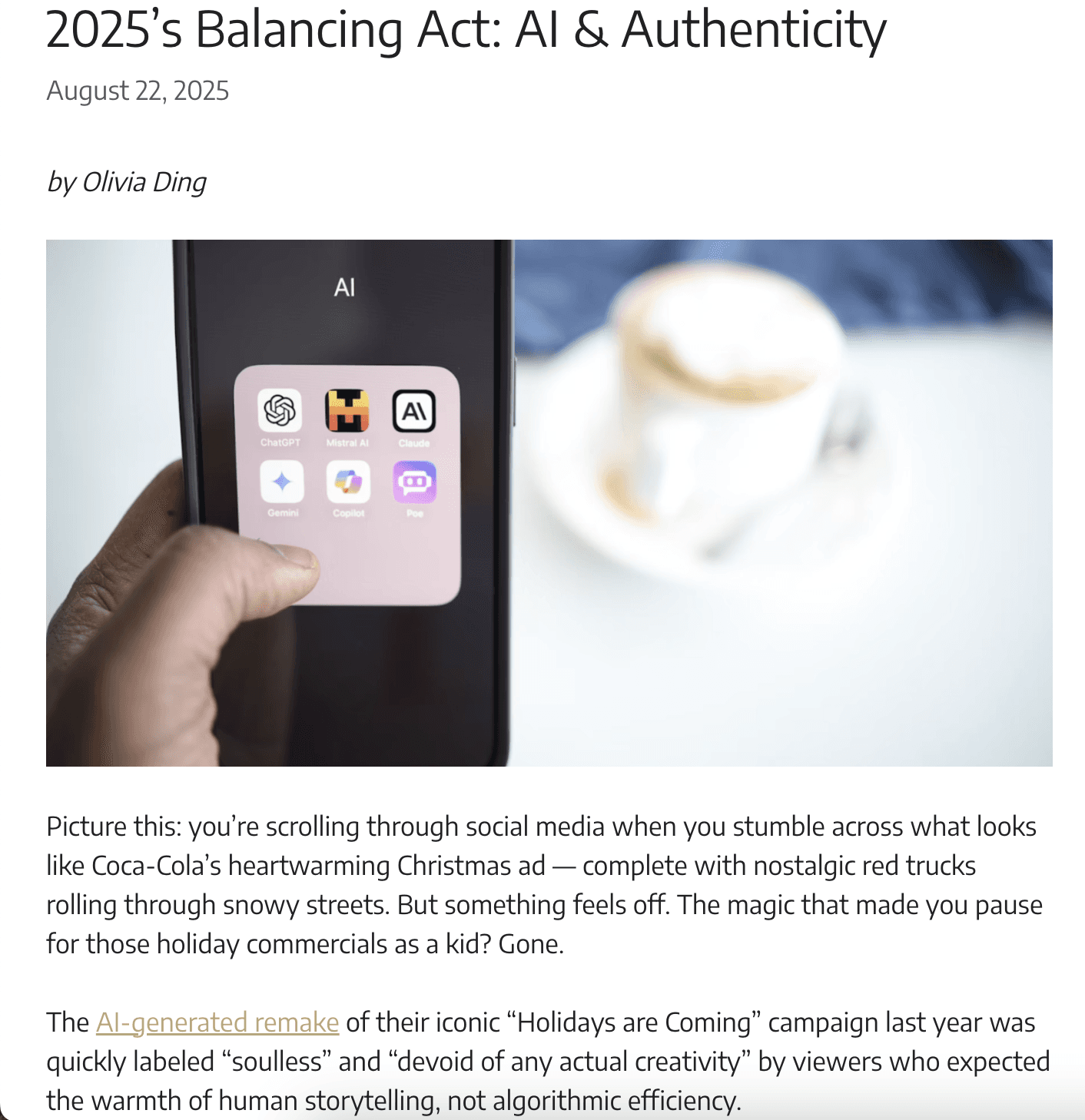
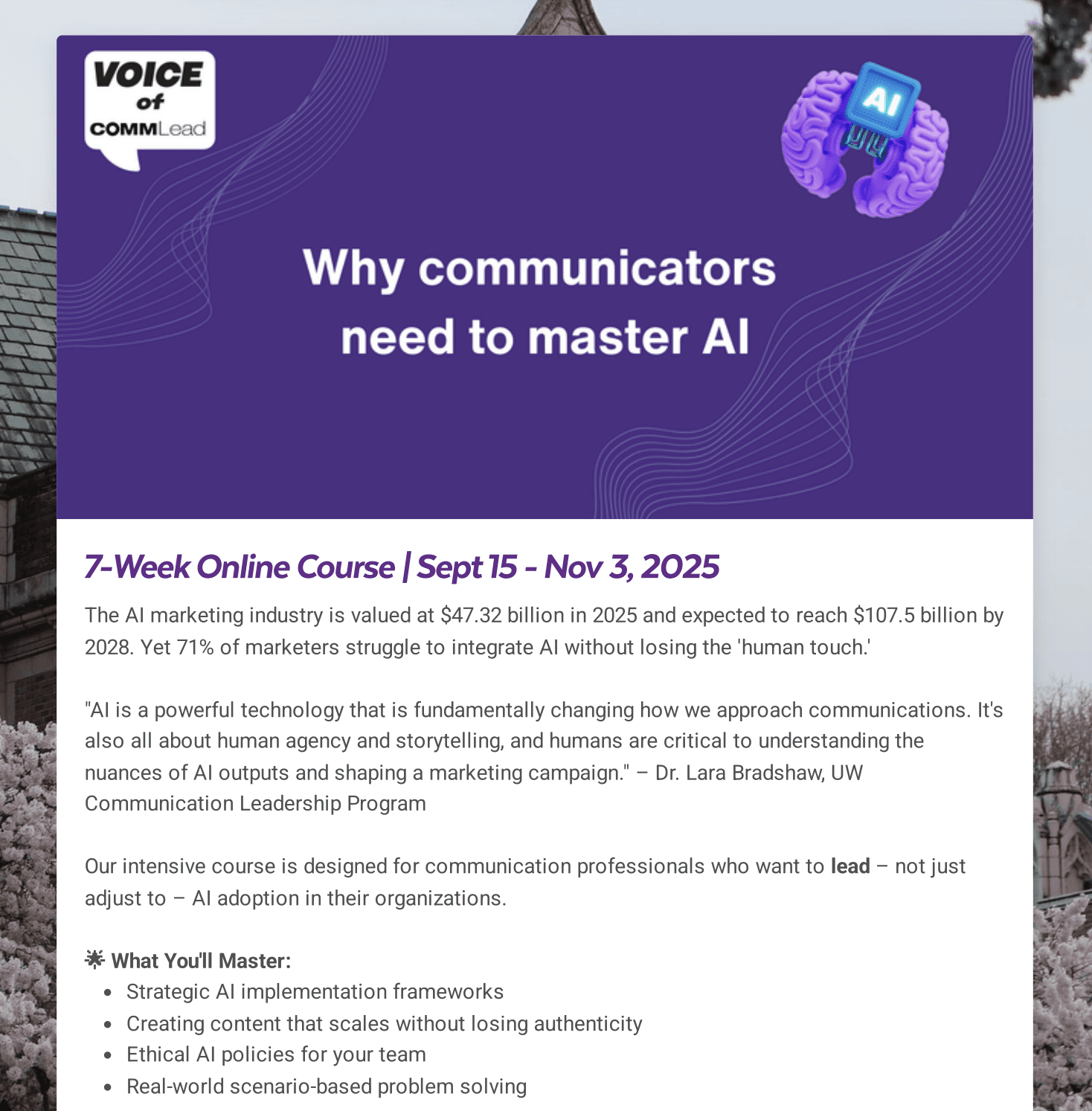
I interviewed instructors and students from the AI in Marketing course, weaving in Brandwatch research showing 71% of marketers struggle to integrate AI without losing the human touch. The content tackled the industry's biggest tension—how to harness AI's $47B market without becoming "soulless"—while promoting the program's 7-week online AI course.
August: AI and Authenticity
Read Full Article
View Newsletter
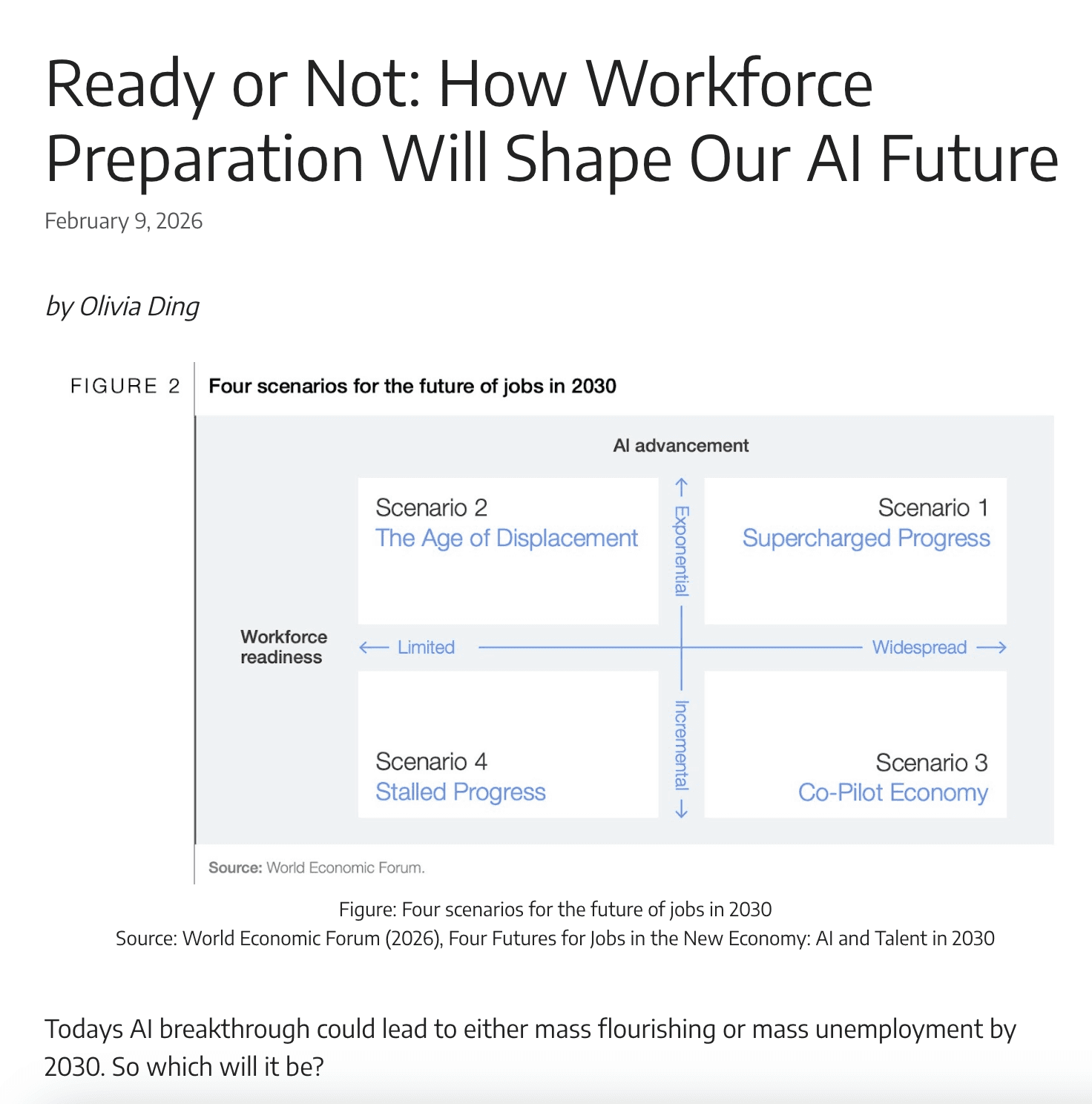
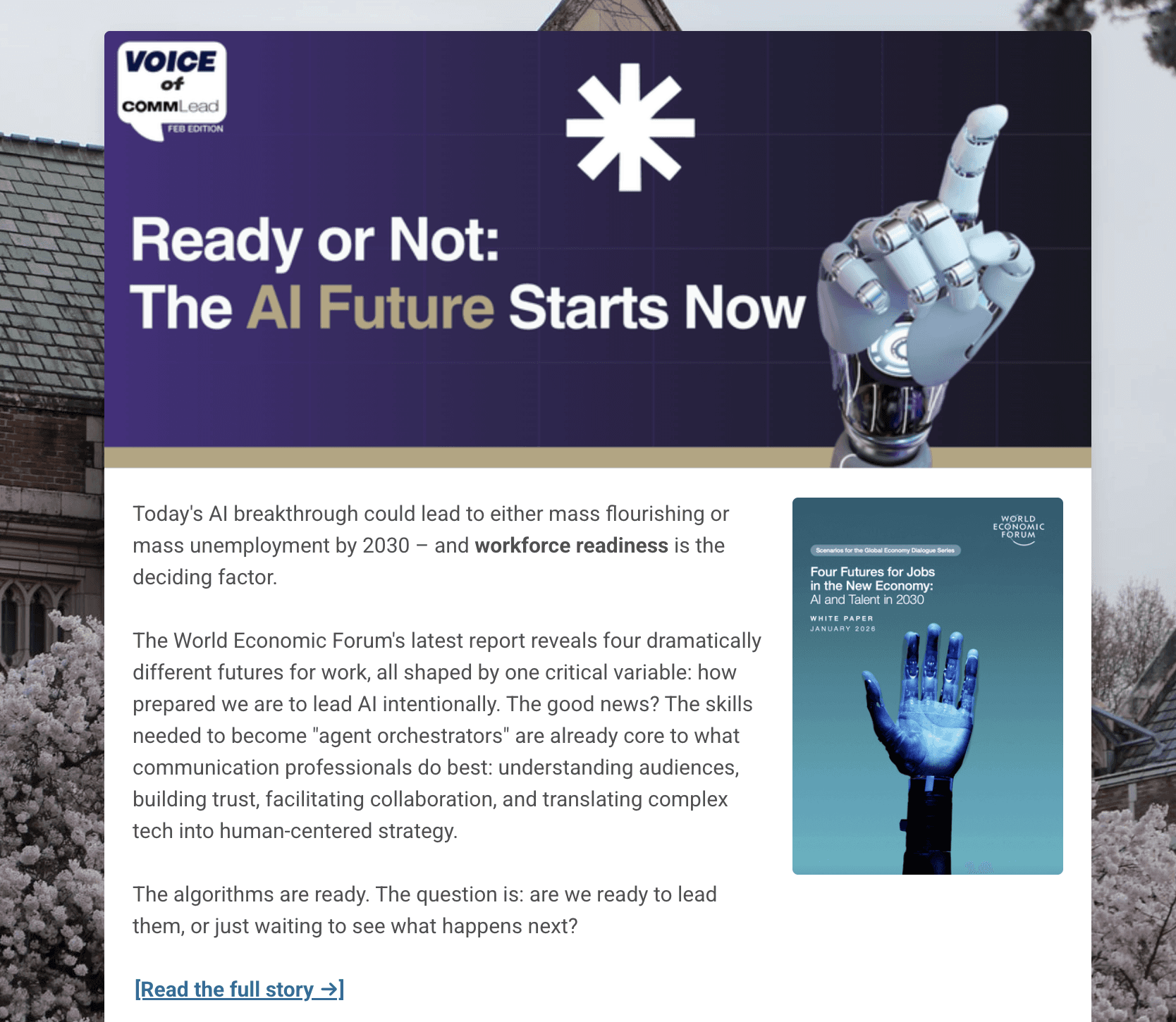
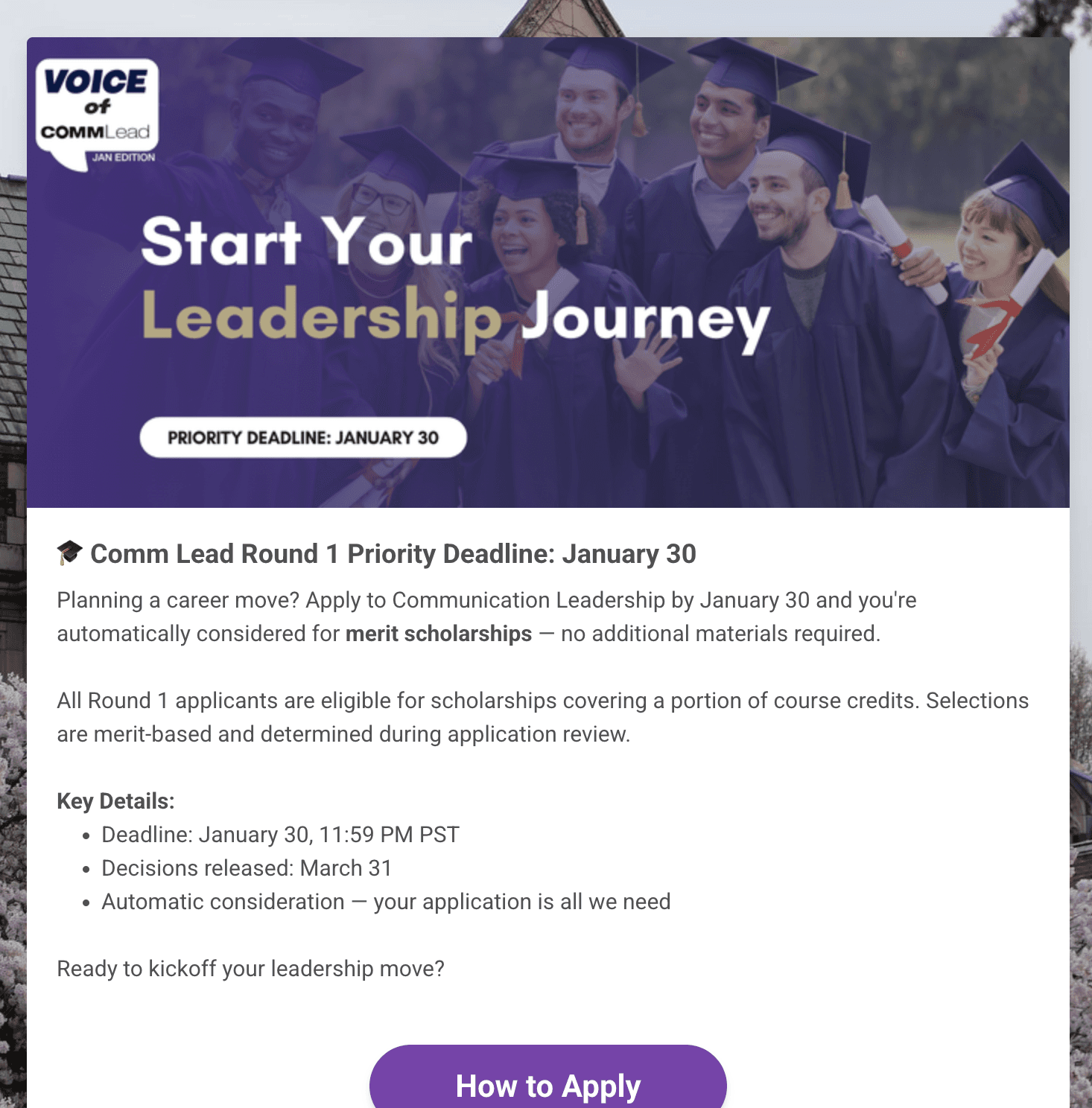
I analyzed the World Economic Forum's January 2026 report exploring how workforce preparation will determine whether AI leads to mass flourishing or displacement by 2030. After interviewing Dr. Lara Bradshaw about UW's AI education philosophy, I argued that the real skill gap isn't about mastering AI tools — it's about developing the judgment to lead them ethically.
The piece connected current hiring trends (analyzing what companies like OpenAI actually seek: professionals who can bridge AI capability and human need) with the program's curriculum approach. By showing how courses like Communicating Trust and Credibility and Law & Ethics of Community Building develop the discernment AI requires, I reframed AI anxiety into opportunity: communication professionals are uniquely positioned to become "agent orchestrators" in this transition. The article promoted both the graduate program and 7-week AI short course while offering genuine career strategy insights.
January: Workforce Readiness in the AI Era
Read Full Article
View Newsletter
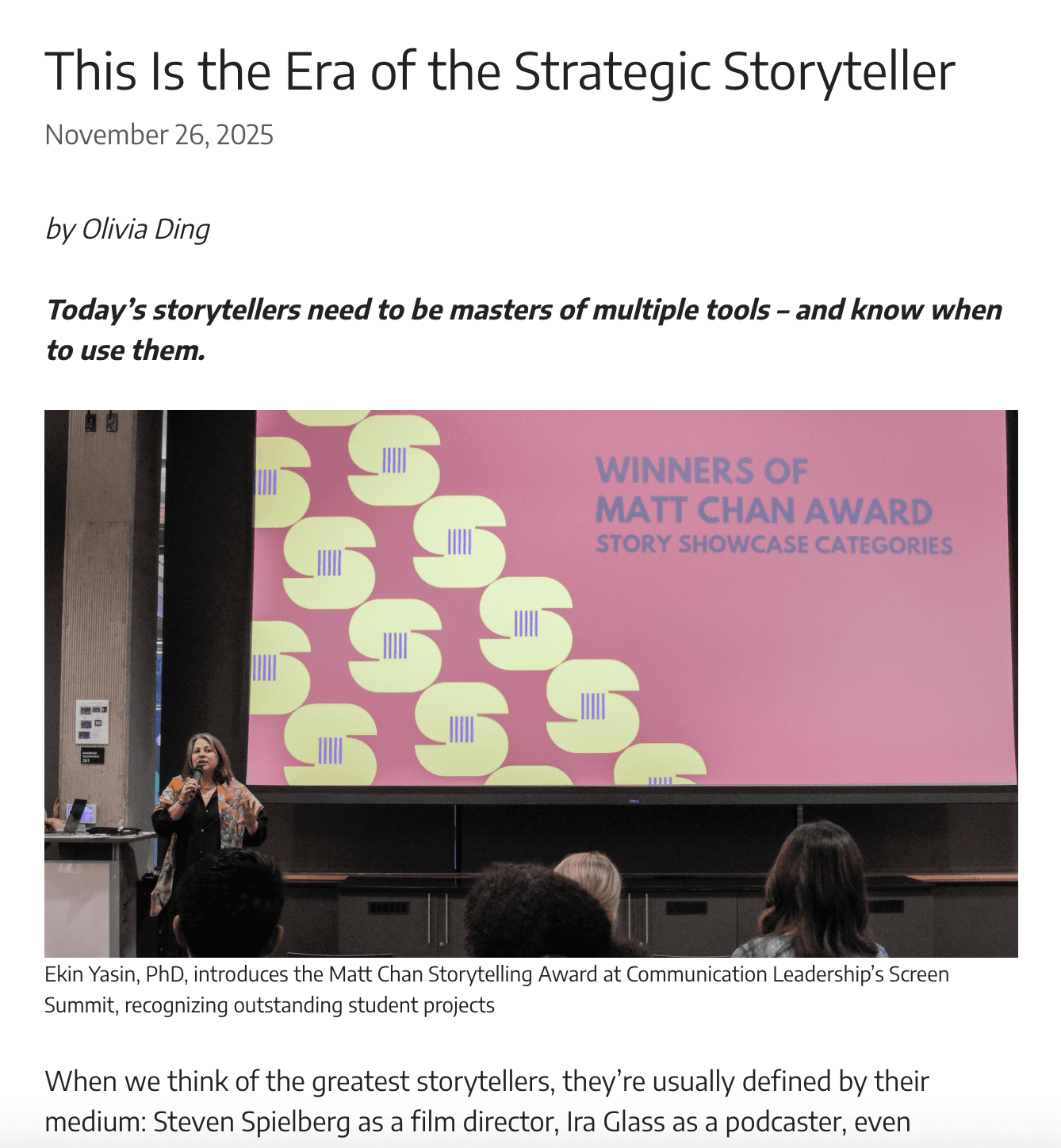
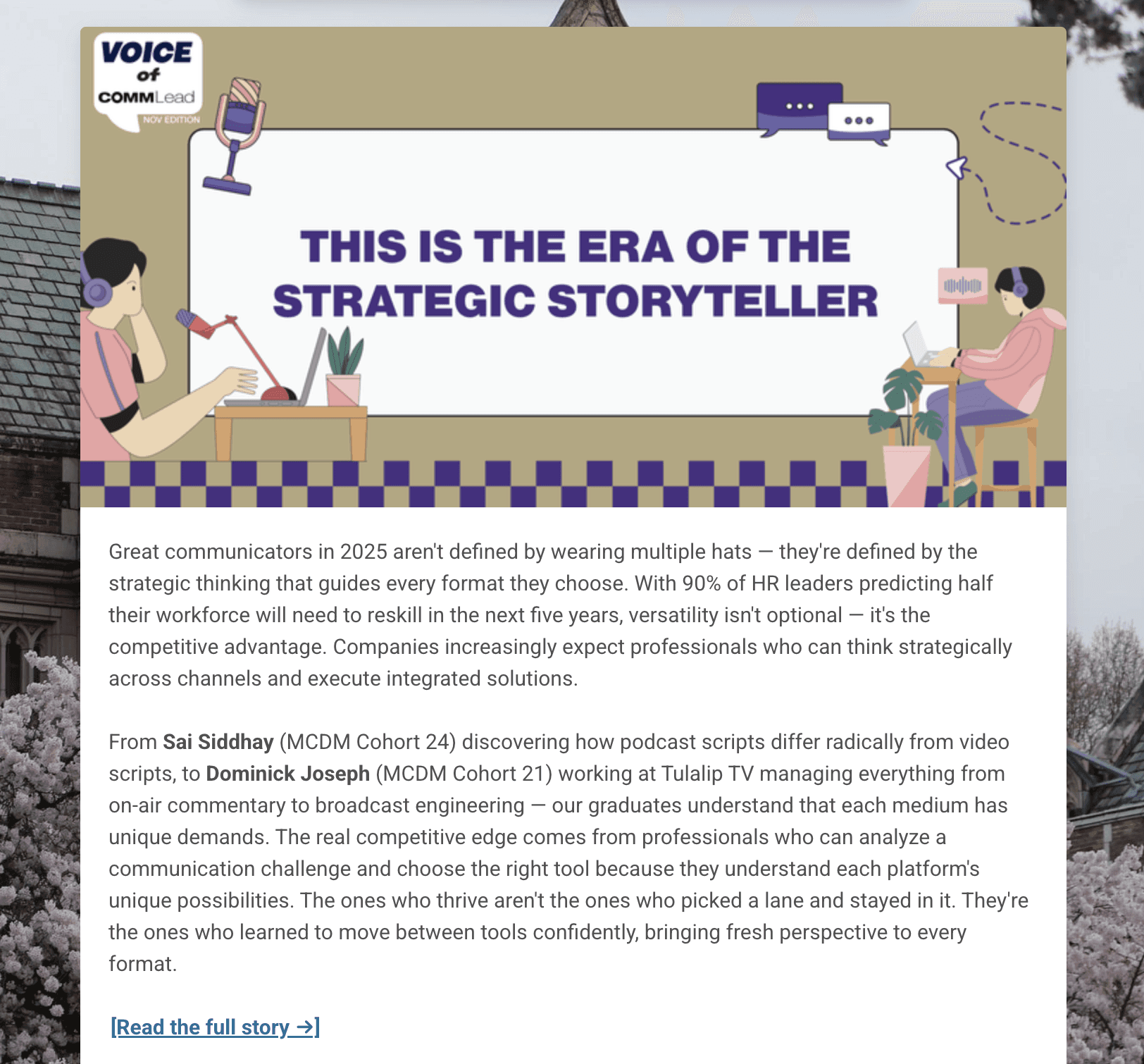
I interviewed filmmaker Elliat Graney-Saucke about her new Foundations of Documentary Storytelling course (new course), paired with three alumni—Dominick Joseph, Sai Siddhay, and Kayla Moani Huitt—who demonstrated how strategic communicators move across platforms with confidence. The piece argued that competitive advantage comes from understanding when to use which tool, not from mastering a single medium.
By centering Elliat's approach to teaching narrative judgment through documentary work, I showed how learning diverse storytelling forms develops the critical thinking that transfers everywhere.
November: The Era of the Strategic Storyteller
Read Full Article
View Newsletter
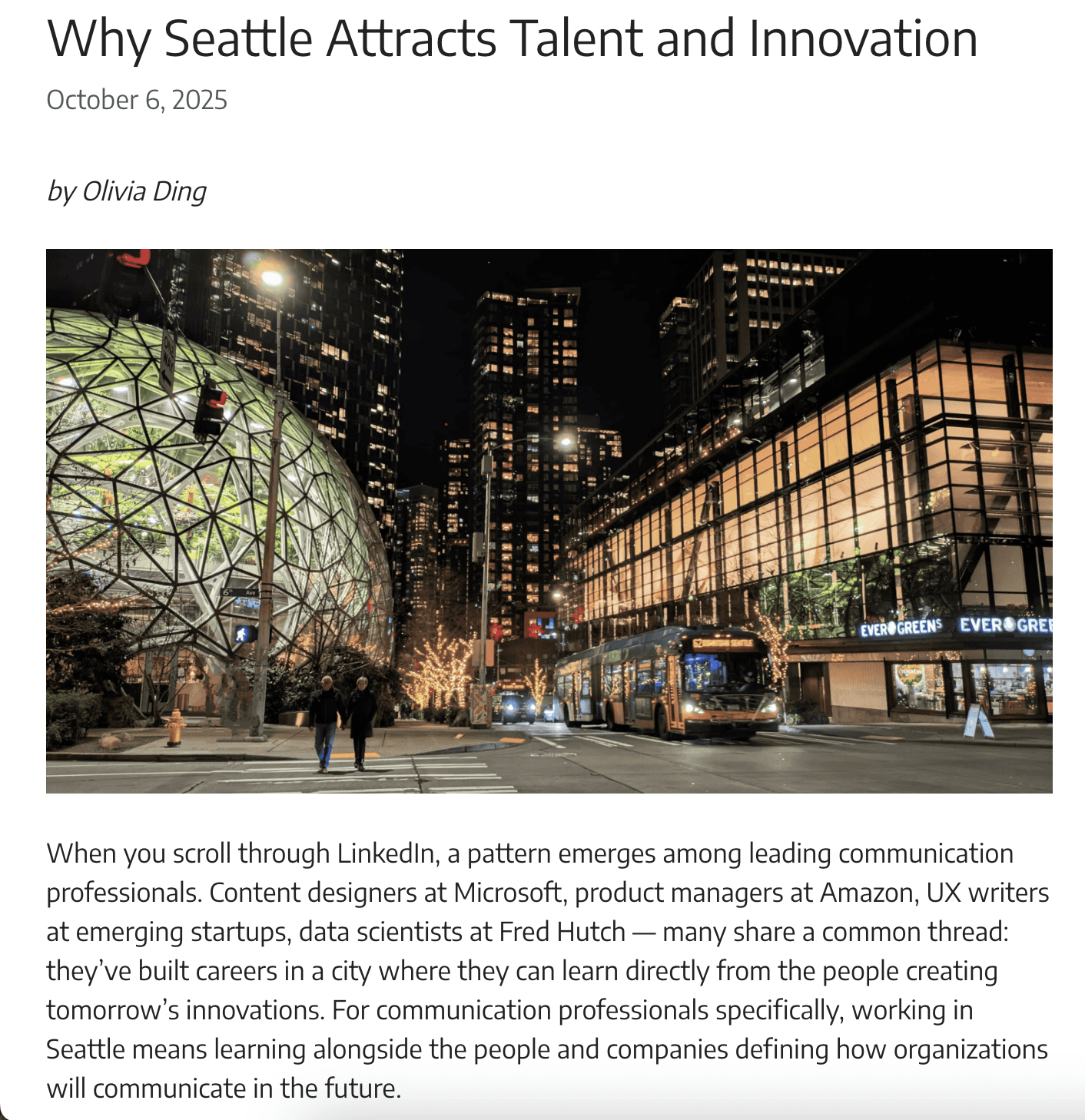
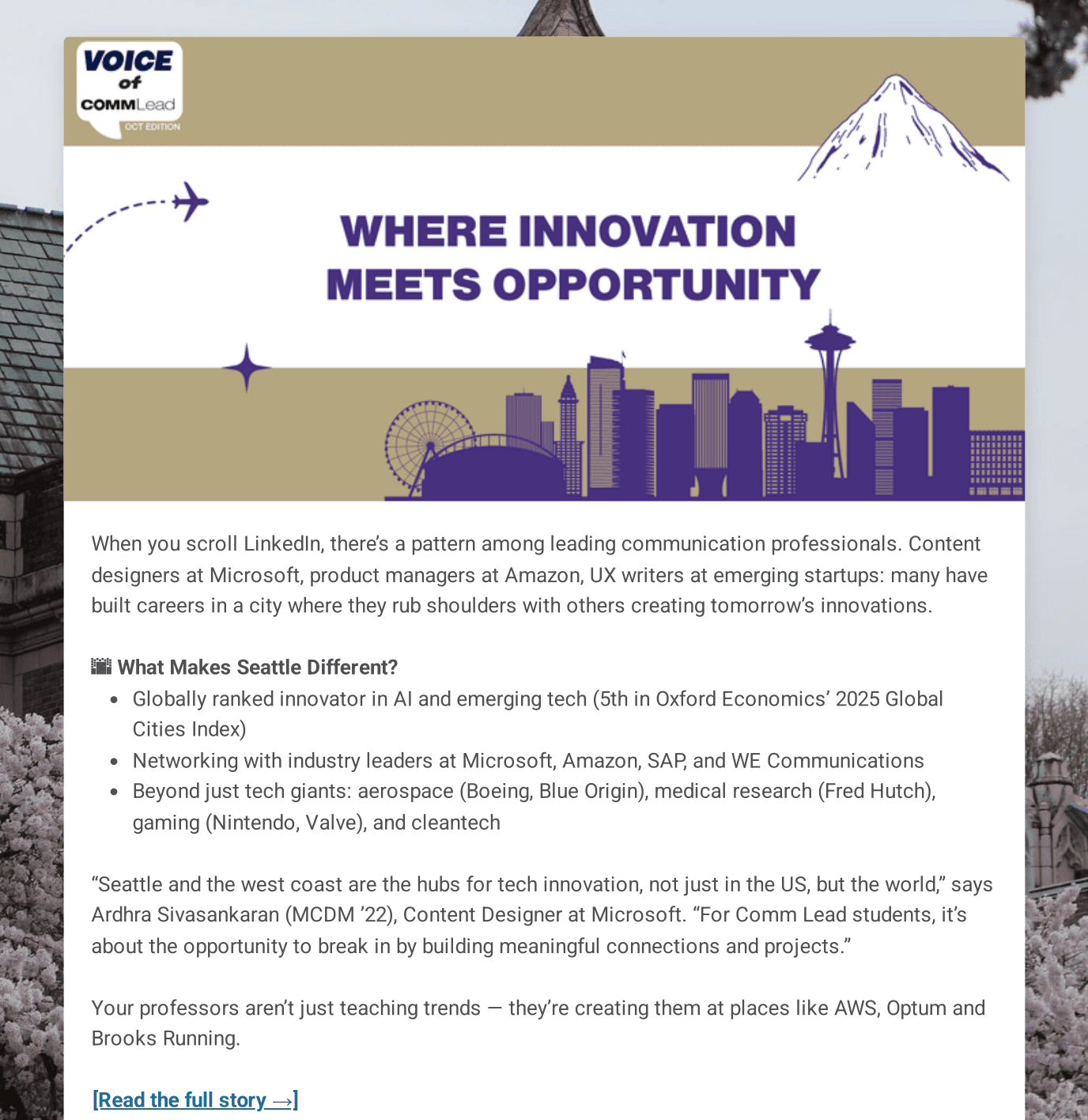
I interviewed alumni working at companies like Microsoft and Tencent, using data from NYU's Cities Emerging Technologies Index and Oxford Economics' Global Cities Index. The piece offered career strategy insights about innovation ecosystems, positioning Seattle (and the program) as a strategic advantage.
October: Why Seattle for Communication Careers
Read Full Article
View Newsletter
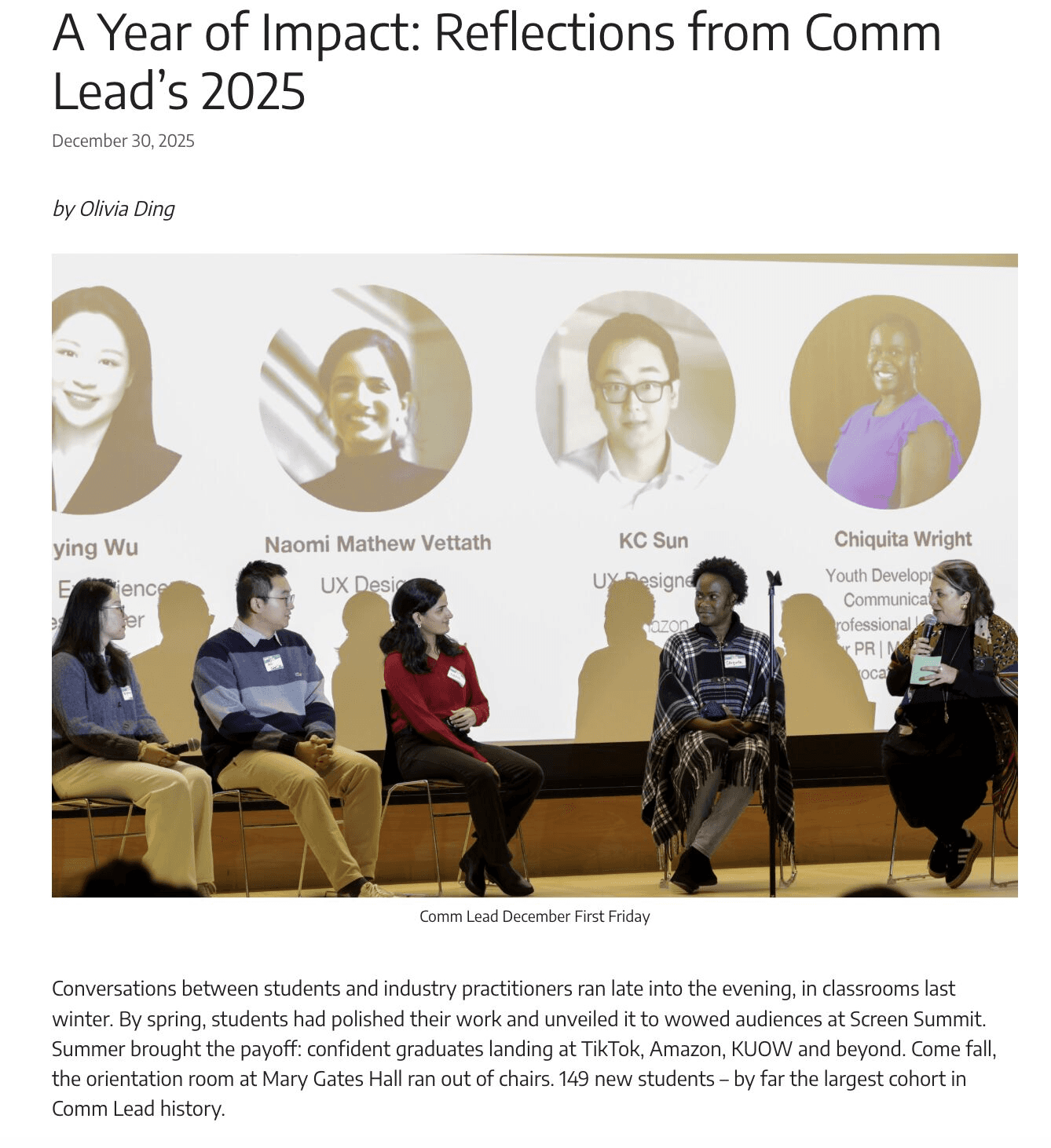
For this year-end piece, I shifted from monthly recruitment campaigns to a comprehensive reflection on our program's 2025 journey. I collaborated with Associate Director Alex and Marketing Specialist Matthew to develop the proposal and narrative framework, identifying which stories and data points would best capture the year's impact.
The research process involved mapping out our major milestones (Connects 2025 reaching 1,000+ professionals, Screen Summit showcases, the AI short course expansion) and tracking student outcomes across three cohorts. I conducted interviews with current students like Matthew, Xiaolan, and Ella to understand how they experienced their first quarter, and spoke with recent graduates like Monica about landing roles at companies like TikTok. I also interviewed alumni like Naomi who returned as mentors, and documentary filmmaker Marley about her Screen Summit journey.
The final article wove together these personal narratives with program data, creating a year-in-review that celebrated both individual transformation and community growth. The piece balanced institutional achievements (149 new students, 4,000+ volunteer hours through Consulting) with intimate moments that made the program feel real. It became both a recruitment tool and a love letter to the community that made this year possible.
December: A Year in Review
Read Full Article
View Newsletter
June: The Future of Community Journalism
I interviewed faculty member Alex Stonehill and explored how local journalism is evolving amid declining media trust. Using data from the 2025 Edelman Trust Barometer, I crafted content that wasn't just promoting the MCCN track—it was giving readers genuine insights into why community-focused storytelling matters, whether they enrolled or not.

July: Launching "Leading the Way" Podcast
I spoke with podcast producer Jessica Partnow and her students about why audio storytelling works when attention spans are shrinking. The campaign introduced the program's new podcast while exploring podcasting as a content marketing strategy—practical insights for anyone in communications, with a natural invitation to learn more through Jessica's course.
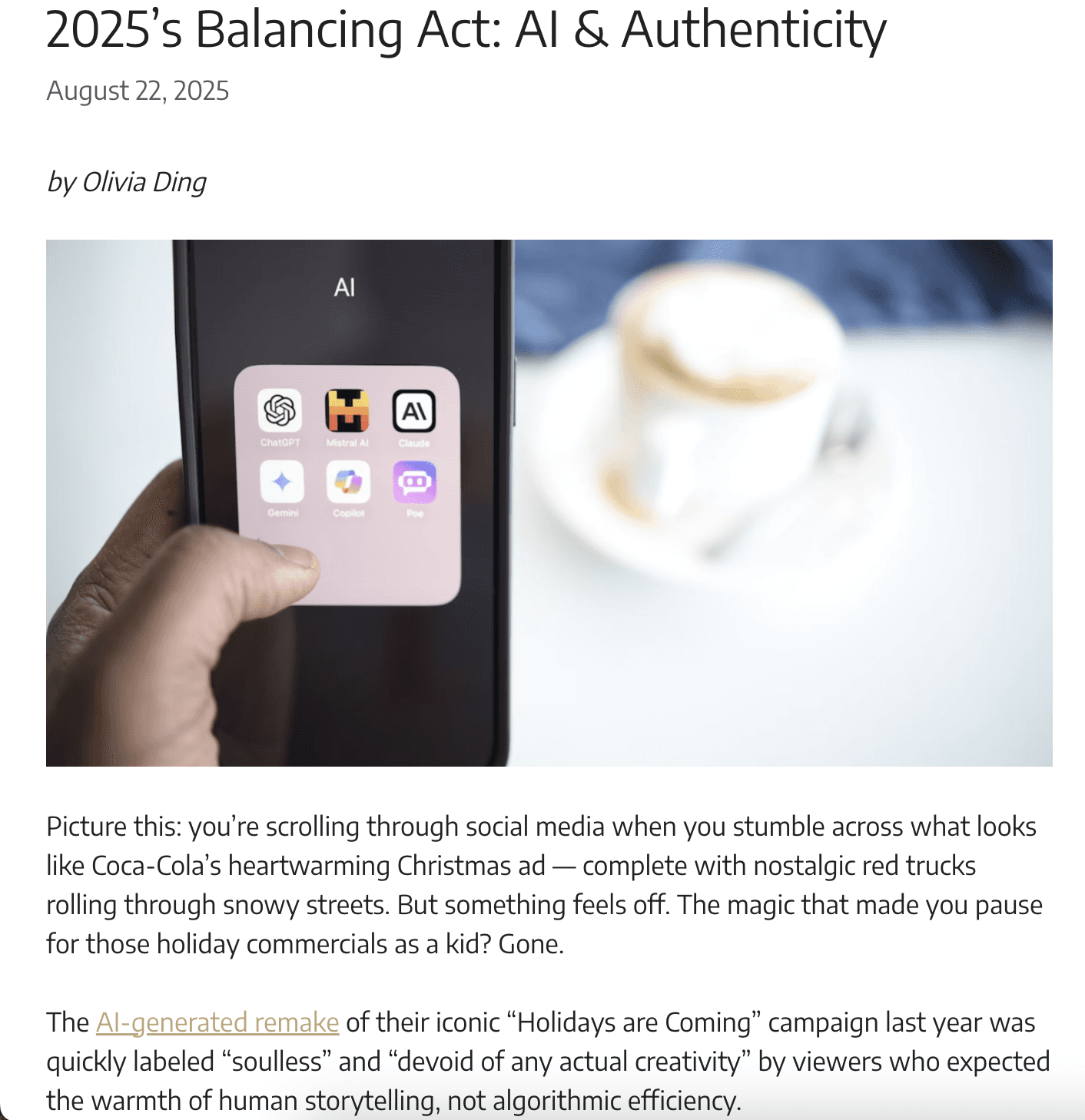
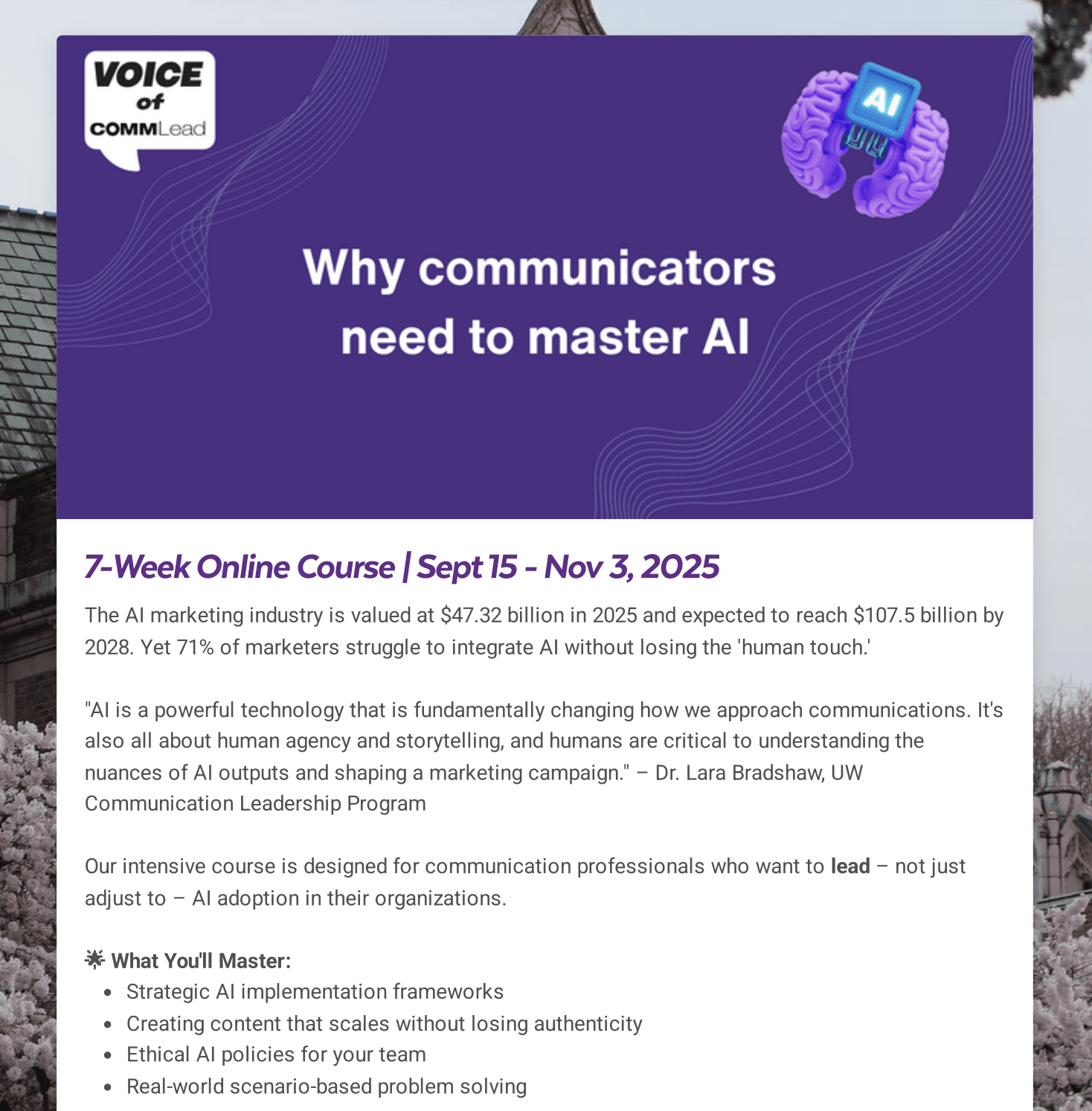
August: AI and Authenticity
I interviewed instructors and students from the AI in Marketing course, weaving in Brandwatch research showing 71% of marketers struggle to integrate AI without losing the human touch. The content tackled the industry's biggest tension—how to harness AI's $47B market without becoming "soulless"—while promoting the program's 7-week online AI course.
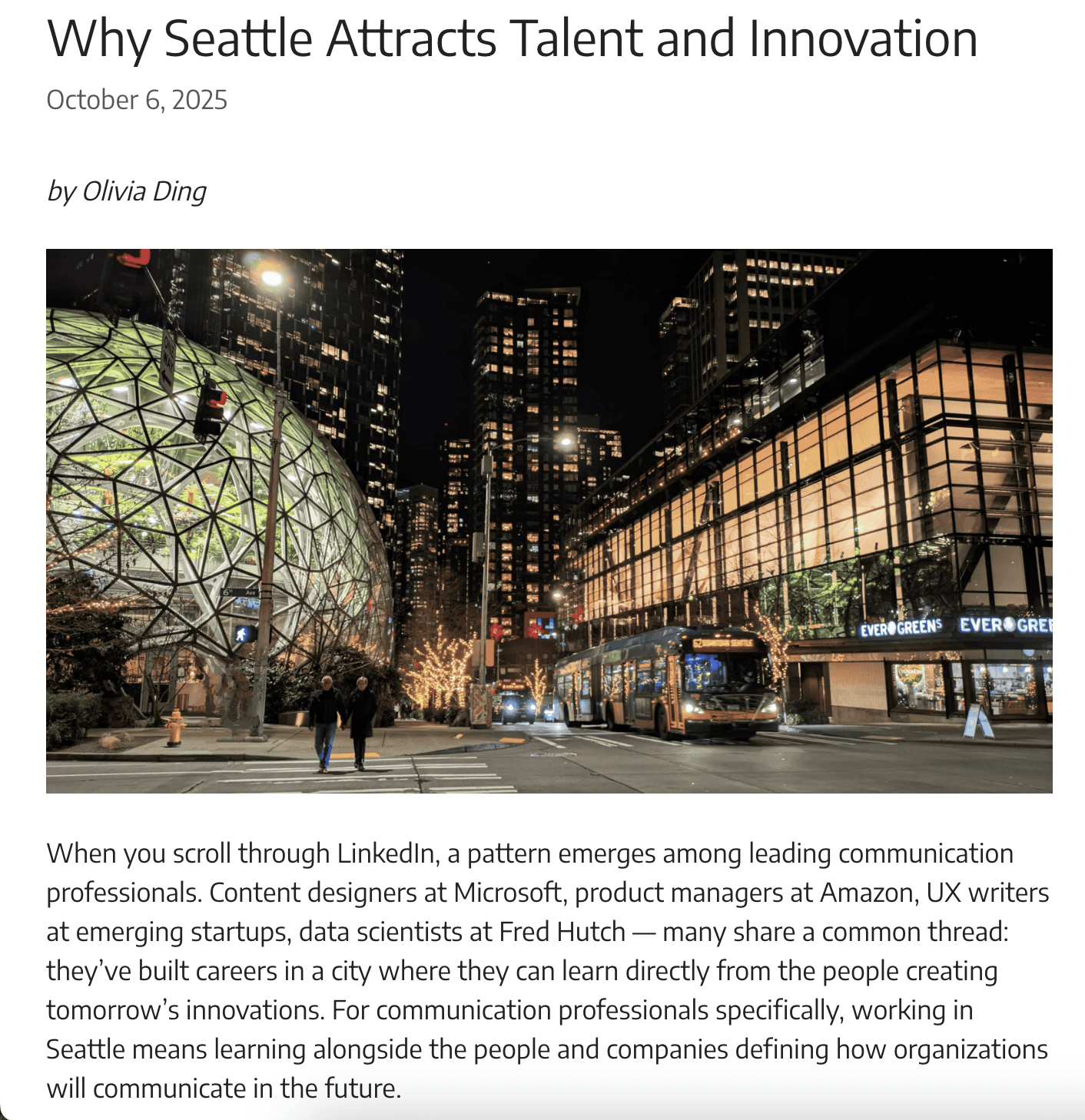
October: Why Seattle for Communication Careers
I interviewed alumni working at companies like Microsoft and Tencent, using data from NYU's Cities Emerging Technologies Index and Oxford Economics' Global Cities Index. The piece offered career strategy insights about innovation ecosystems, positioning Seattle (and the program) as a strategic advantage.
November: The Era of the Strategic Storyteller
I interviewed filmmaker Elliat Graney-Saucke about her new Foundations of Documentary Storytelling course (new course), paired with three alumni—Dominick Joseph, Sai Siddhay, and Kayla Moani Huitt—who demonstrated how strategic communicators move across platforms with confidence. The piece argued that competitive advantage comes from understanding when to use which tool, not from mastering a single medium.
By centering Elliat's approach to teaching narrative judgment through documentary work, I showed how learning diverse storytelling forms develops the critical thinking that transfers everywhere.
December: A Year in Review
For this year-end piece, I shifted from monthly recruitment campaigns to a comprehensive reflection on our program's 2025 journey. I collaborated with Associate Director Alex and Marketing Specialist Matthew to develop the proposal and narrative framework, identifying which stories and data points would best capture the year's impact.
The research process involved mapping out our major milestones (Connects 2025 reaching 1,000+ professionals, Screen Summit showcases, the AI short course expansion) and tracking student outcomes across three cohorts. I conducted interviews with current students like Matthew, Xiaolan, and Ella to understand how they experienced their first quarter, and spoke with recent graduates like Monica about landing roles at companies like TikTok. I also interviewed alumni like Naomi who returned as mentors, and documentary filmmaker Marley about her Screen Summit journey.
The final article wove together these personal narratives with program data, creating a year-in-review that celebrated both individual transformation and community growth. The piece balanced institutional achievements (149 new students, 4,000+ volunteer hours through Consulting) with intimate moments that made the program feel real. It became both a recruitment tool and a love letter to the community that made this year possible.
January: Workforce Readiness in the AI Era
I analyzed the World Economic Forum's January 2026 report exploring how workforce preparation will determine whether AI leads to mass flourishing or displacement by 2030. After interviewing Dr. Lara Bradshaw about UW's AI education philosophy, I argued that the real skill gap isn't about mastering AI tools — it's about developing the judgment to lead them ethically.
The piece connected current hiring trends (analyzing what companies like OpenAI actually seek: professionals who can bridge AI capability and human need) with the program's curriculum approach. By showing how courses like Communicating Trust and Credibility and Law & Ethics of Community Building develop the discernment AI requires, I reframed AI anxiety into opportunity: communication professionals are uniquely positioned to become "agent orchestrators" in this transition. The article promoted both the graduate program and 7-week AI short course while offering genuine career strategy insights.
Key Learnings
Key Learnings
Content strategy isn't just about what you say — it's about who gets to speak.
Content strategy isn't just about what you say — it's about who gets to speak.
The most compelling marketing came from stepping back and letting alumni and students tell their own stories. I learned this most clearly in the October Seattle careers piece — instead of writing generic claims about "great job opportunities," I let alumni like Ardhra Sivasankaran (now at Microsoft) and Haya Wang (now at Tencent) explain in their own words what makes Seattle valuable. Their authentic voices talking about nervous coffee chats and breaking into tight-knit industries resonated far more than any marketing copy I could've written. My job was to create the stage and let others perform.
The most compelling marketing came from stepping back and letting alumni and students tell their own stories. I learned this most clearly in the October Seattle careers piece — instead of writing generic claims about "great job opportunities," I let alumni like Ardhra Sivasankaran (now at Microsoft) and Haya Wang (now at Tencent) explain in their own words what makes Seattle valuable. Their authentic voices talking about nervous coffee chats and breaking into tight-knit industries resonated far more than any marketing copy I could've written. My job was to create the stage and let others perform.
Good writing serves the reader first, not the institution.
Good writing serves the reader first, not the institution.
This philosophy shaped everything, especially how I structured content. I learned to break newsletters into clear, scannable sections — "Why This Matters," "Real Stories," "What's Next" — so readers could extract value in 90 seconds or dive deeper if intrigued. When writing the AI piece, I opened with Coca-Cola's controversial AI ad, not with our course description. Why? Because prospective students searching for AI information needed context first. They needed to understand the industry problem before considering our solution. Even if they never enrolled, they left with something useful — and that's how you build trust over time.
This philosophy shaped everything, especially how I structured content. I learned to break newsletters into clear, scannable sections — "Why This Matters," "Real Stories," "What's Next" — so readers could extract value in 90 seconds or dive deeper if intrigued. When writing the AI piece, I opened with Coca-Cola's controversial AI ad, not with our course description. Why? Because prospective students searching for AI information needed context first. They needed to understand the industry problem before considering our solution. Even if they never enrolled, they left with something useful — and that's how you build trust over time.
Marketing for education is trust-building, not selling— and SEO is how you start that conversation.
Marketing for education is trust-building, not selling — and SEO is how you start that conversation.
I learned to think about search intent and the reader's journey. When someone searches "community journalism jobs," they're not ready to apply to grad school — they're exploring career paths. So the June article answered that question first with faculty insights and real examples, before naturally introducing how MCCN prepares students for this shift. This meant optimizing headlines ("Why Seattle Attracts Talent and Innovation" vs. generic "Seattle Communications Jobs"), researching keywords, and respecting that not every piece needs a hard sell. Some months, the CTA was simply "subscribe to our podcast" — low-pressure invitations that kept the conversation going. The best campaigns didn't push, they invited.
I learned to think about search intent and the reader's journey. When someone searches "community journalism jobs," they're not ready to apply to grad school — they're exploring career paths. So the June article answered that question first with faculty insights and real examples, before naturally introducing how MCCN prepares students for this shift. This meant optimizing headlines ("Why Seattle Attracts Talent and Innovation" vs. generic "Seattle Communications Jobs"), researching keywords, and respecting that not every piece needs a hard sell. Some months, the CTA was simply "subscribe to our podcast" — low-pressure invitations that kept the conversation going. The best campaigns didn't push, they invited.